Introduction
Your electricity bill arrives every month without fail. For most industrial and commercial facilities in India, that number keeps climbing. Here’s what changes when you use a commercial solar ROI calculator before making any decision: you stop guessing and start knowing exactly what solar will deliver for your specific facility.
Solar ROI is not a generic number. It depends on your energy consumption, rooftop capacity, local tariffs, and system design. This guide walks you through every factor that determines your returns, so you can evaluate solar as the business investment it truly is.
What Does a Commercial Solar ROI Calculator Actually Measure?
A commercial solar ROI calculator estimates three things: how much your system will generate annually, how much money that generation saves against your current tariff, and how many years it takes to recover your investment.
The calculation starts with your monthly electricity bills. Twelve to twenty-four months of consumption data gives you a reliable baseline. From there, system size is determined, annual generation is estimated using irradiance data, and savings are calculated by multiplying generation against your applicable tariff rate.
Most industrial facilities in Tamil Nadu achieve payback within four to six years. After that, the system generates near-free electricity for the remaining twenty-plus years of its operational life.
You can use the Energium Solar Calculator to get a personalised estimate based on your facility’s actual consumption and location.
Why Generic Solar ROI Estimates Are Often Wrong
Most online commercial solar ROI calculators give you a number based on average assumptions. Average irradiance. Average tariff. Average roof. Your facility is not average.
A spinning mill running three shifts has a completely different consumption profile than a warehouse operating only during daylight hours. A rooftop with shading from adjacent structures generates significantly less than an open, unobstructed roof. When these variables are ignored, ROI projections look great on paper but underdeliver in reality.
This is exactly why Energium’s industrial rooftop solar process begins with a detailed site evaluation and shadow analysis before any system sizing or projection is made. Accurate ROI starts with accurate data.
Key Factors That Determine Your Commercial Solar ROI
Energy Consumption Pattern Facilities that consume most of their energy during daylight hours benefit the most from solar. Manufacturing units, textile mills, and commercial buildings with consistent daytime operations are ideal candidates. The higher your daytime self-consumption, the stronger your ROI.
Current Electricity Tariff Industrial tariffs in Tamil Nadu typically range between Rs 6 and Rs 9 per unit. The higher your current rate, the faster solar pays back. With tariffs rising annually, locking in solar generation today protects your facility from future increases for twenty-five years.
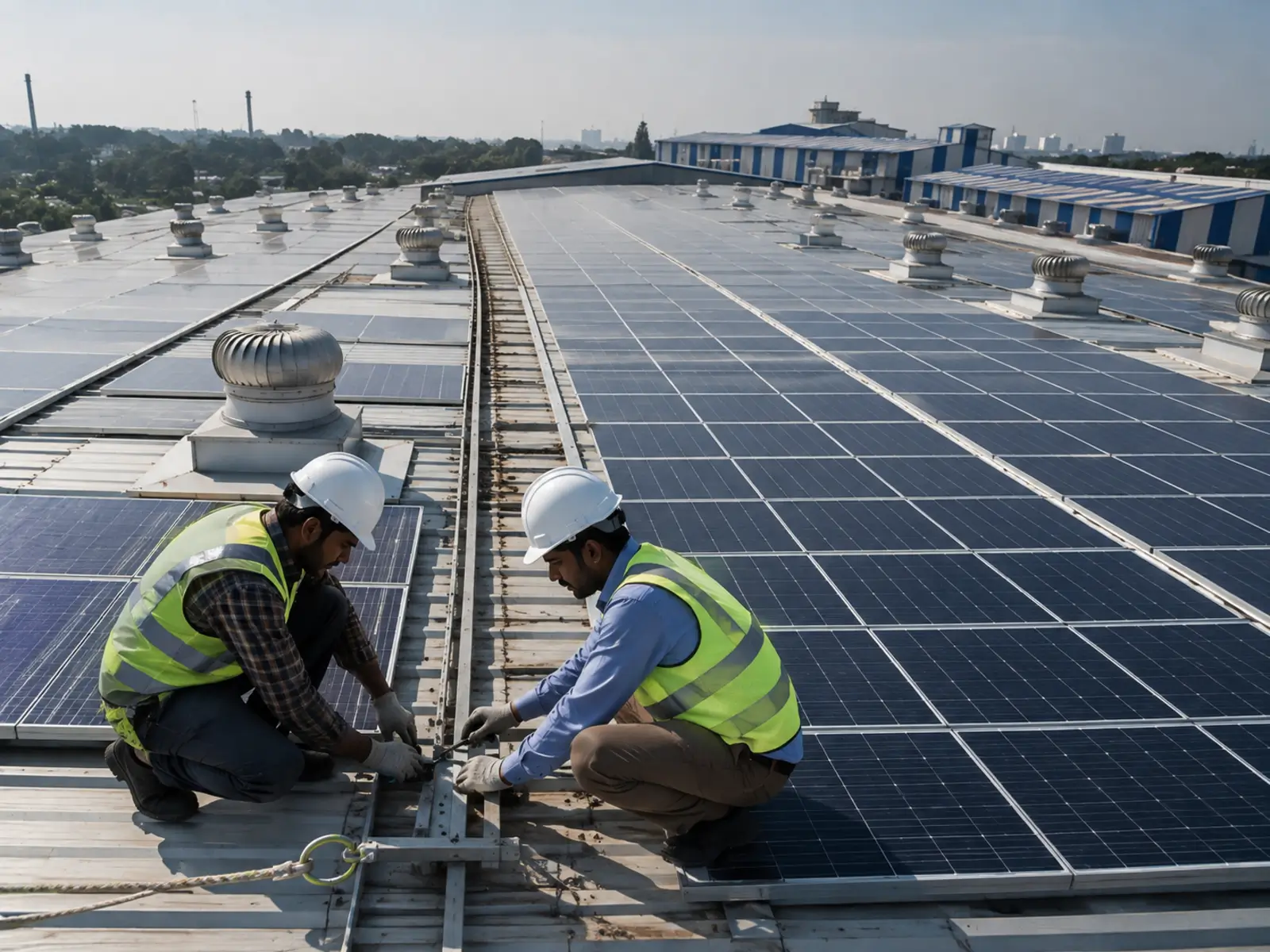
Rooftop Quality and Shadow-Free Area Not every square foot of your roof is useful. Shadows from vents, water tanks, adjacent buildings, and equipment reduce generation significantly. A thorough shadow analysis determines the actual usable area, which directly impacts your system size and returns.
System Design and Component Quality A correctly sized system with Tier-1 panels and properly matched inverters generates more over its lifetime than an oversized or undersized system with generic components. As detailed in Energium’s data-driven solar design approach, system design choices made before installation determine decades of performance.
How to Calculate Commercial Solar ROI Step by Step
Step one is analysing your electricity bills. Look at your average monthly consumption in units and your per-unit tariff. Multiply these to get your monthly energy cost.
Step two is determining your optimal system size. As a rough guide, 1 kW of solar generates approximately 4 to 4.5 units per day in Tamil Nadu under good irradiance conditions. Match your system size to your daytime consumption, not your total consumption.
Step three is estimating annual savings. Multiply your annual generation by your current tariff. This is your yearly saving before accounting for any grid export.
Step four is calculating payback. Divide your total system cost by your annual savings. The result is your payback period in years.
Step five is understanding long-term returns. After payback, your system continues generating for twenty-plus years. The commercial solar ROI calculation framework developed by Energium shows how post-payback generation typically delivers two to four times the original investment over a system’s lifetime.
What Energium’s Commercial Solar ROI Process Looks Like in Practice
At Energium, ROI calculation is not a sales tool. It is an engineering assessment. Before recommending any system, the team evaluates whether solar genuinely makes financial sense for your facility. If it does not, they say so.
For a 375 kW installation at Sri Balaji Textiles in Erode, every projection was backed by detailed load analysis and shading studies. For a 99 kW ground-mounted system at Mahavishnu Rapiers in Perundurai, unused land was identified and shadow patterns from fourteen coconut trees were mapped to ensure generation projections were accurate from day one. See the full project details here.
This engineering-first approach means clients receive ROI projections they can actually rely on, not optimistic numbers designed to close a sale.
Is Commercial Solar the Right Investment for Your Facility Right Now?
Solar delivers strong ROI when three conditions align: your facility has sufficient daytime consumption, your rooftop has adequate shadow-free area, and your current tariff is high enough to generate meaningful savings.
According to the Ministry of New and Renewable Energy, India added over 24 GW of solar capacity in 2024 alone, reflecting the growing confidence businesses have in solar as a long-term investment. For industrial and commercial facilities in Tamil Nadu, where tariffs are rising and solar irradiance is among the highest in the country, the conditions are strongly favourable.
The right question is not whether solar works. It is whether your specific facility is ready for it. That answer requires data, not assumptions.
Conclusion
A commercial solar ROI calculator gives you a starting point. Accurate projections require site-specific data, honest assessment, and engineering discipline. When those elements come together, solar stops being a cost and becomes one of the most reliable long-term investments your facility can make.
The facilities that invest in accurate ROI analysis today are the ones that capture maximum value over the next twenty-five years. Your rooftop is already receiving free energy every single day. The question is how much of it you are capturing.